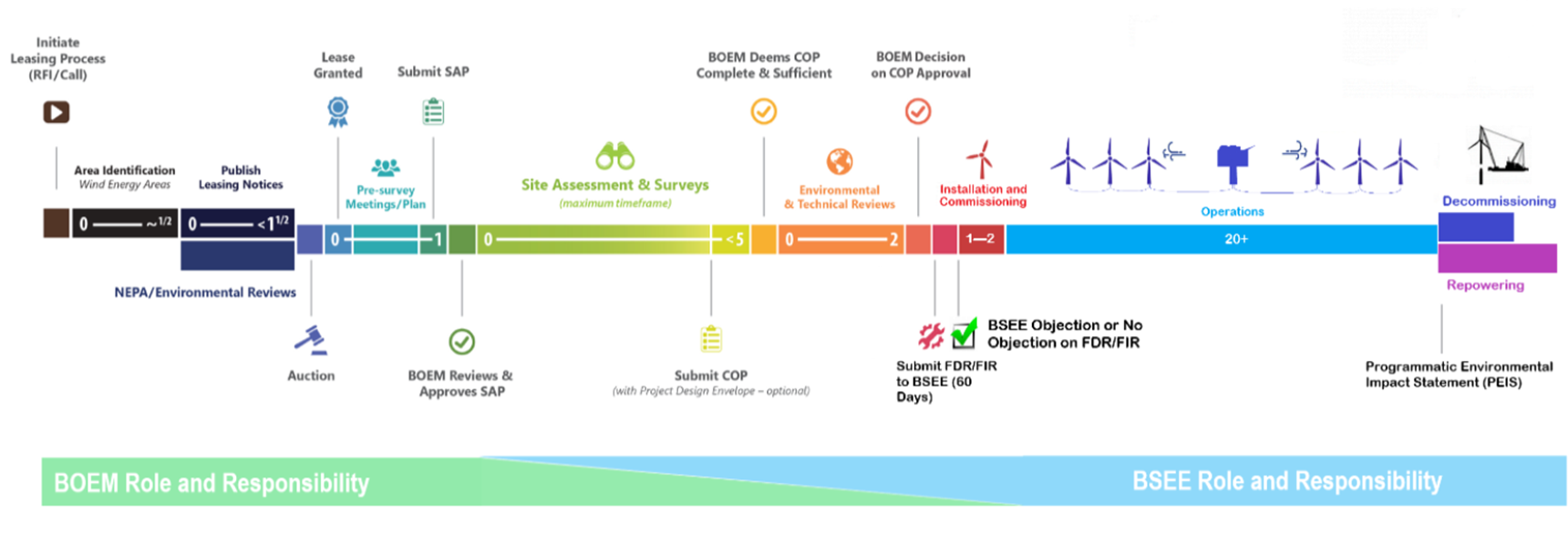
The BOEM Process
Offshore wind offers immense promise as a renewable energy source capable of reducing our reliance on fossil fuels and mitigating climate change. However, the path from the initial concept of an offshore wind farm to a fully operational project, with turbines spinning at sea and delivering clean power, is long and complex. As required by the Energy Policy Act of 2005 (EPAct), all offshore wind development in federal waters of the United States (more than 3 nautical miles [nm] from shore for most coastal states, though exceptions to this include Texas, the Gulf Coast of Florida, and the Commonwealth of Puerto Rico where jurisdiction extends 9 nm from shore) must undergo a robust review process before any wind turbine can be installed and become operational. The EPAct authorizes the Bureau of Ocean Energy Management (BOEM) to issue leases, easements, and rights-of-way for renewable energy projects on the Outer Continental Shelf (OCS), making it one of the lead agencies for U.S. offshore wind energy development. The offshore wind energy development process is divided into four phases. BOEM oversees the Planning and Analysis, Leasing, Site Assessment, and the Construction and Operations phase of development. The Bureau of Safety and Environmental Enforcement (BSEE) also plays a key role in overseeing this process and ensuring regulatory compliance throughout operations, making it the other lead agency involved in offshore wind development.
As an environmental organization advocating for the responsible development of offshore wind, the National Wildlife Federation works to ensure that BOEM offshore wind process upholds strong wildlife protection standards while advancing our climate and renewable energy goals. Our work strives to embed the mitigation hierarchy, to first avoid, then minimize, mitigate, and monitor impacts of offshore wind on wildlife and ecosystems. Through advocacy, policy development, and involvement in litigation via amicus briefs, we advance species protections, ecosystem conservation, and other mitigation efforts to ensure that offshore wind energy develops responsibly. We work alongside and partner with other environmental NGOs (eNGOs) to engage with BOEM, Tribes and Tribal entities, state agencies, coastal communities, and developers throughout this approximately ten year process. Our work spans a wide range of activities, from on-the-ground advocacy, education, and campaigning with local government bodies, partners, and community members, to supporting responsible development by providing expertise on environmental and wildlife impacts to agencies through formal comments, informal letters, and information requests. Additionally, we draft collaborative amicus briefs in litigation concerning the responsible development of offshore wind and participate in leading regional wildlife science forums to ensure the best available science is collected, properly stored, and used to inform all development decisions.
BOEM divides the offshore wind energy development process into four stages: 1) Planning and Analysis; 2) Leasing; 3) Site Assessment; and 4) Construction and Operations. Navigate to each stage to learn about the BOEM process and how the National Wildlife Federation is involved in each step, from conception to construction.
To jump to each phase of the BOEM Process, click on one of the pages below:
Planning and Analysis
Leasing
Site Assessment
Construction and Operations
Find a glossary of acronyms used throughout this text at the bottom of the page.
Please note that we are currently updating the visuals on this page. Graphics may not reflect the current BOEM process. (December 2025)
How the BOEM renewable energy process gets started:
The offshore wind development process can begin in several ways —through a state, regional, or developer expression of interest, or at the direction of the federal government. Once initiated, BOEM undertakes the following steps:
I. Planning and Analysis:
The Planning and Analysis phase identifies the most suitable areas for potential offshore wind energy leasing through a collaborative, consultative, and data-driven process. BOEM aims to ensure that potential offshore wind areas are identified responsibly by balancing national interests —including energy needs and defense priorities— with environmental protection, Tribal priorities and uses, meaningful community member engagement, and a thorough analysis of ocean uses and resources. During this phase, BOEM engages with interested and impacted parties, Tribal Nations, and State and Federal government agencies to gather input and evaluate potential opportunities and concerns. BOEM conducts environmental compliance reviews and formal consultations at this stage. The Planning and Analysis phase includes the following steps:
The Request for Interest in Commercial Leasing (RFI) is the first opportunity to comment on an area being considered for the development of offshore wind on the Outer Continental Shelf. BOEM may use an RFI to determine whether to schedule a competitive lease sale (meaning, multiple developers express interest in that lease area) or to issue a noncompetitive lease for any portion of the area described in the RFI.
NWF participates in these comment periods by convening our species experts, listening to key local and regional stakeholders, attending public Task Force Meetings, and additional stakeholder outreach to determine the feasibility and interest in pursuing offshore wind development in the defined region. NWF follows the mitigation hierarchy to avoid, minimize, mitigate, and monitor impacts of offshore wind on the environment. This stage is critical to avoiding the highest conflict areas and thus, avoid the most serious and unmitigable impacts of development. We consolidate our findings into technical comments which we often send to our eNGO colleagues to support and sign on.
The Call for Information and Nominations (Call) is required by regulation (30 CFR part 585) and is often the first opportunity to comment on discrete areas (Call Area) being considered for offshore wind development. If BOEM determines there is competitive interest, then comments in response to the RFI, information shared in intergovernmental task force meetings, and other discussions and negotiations are used by BOEM to identify the Call Area(s), which is a subset of the area covered in the RFI. The Call Area is published in the Federal Register and open for public comment.
NWF participates in these comment periods by convening our species experts, listening to key local and regional stakeholders, attending public Task Force Meetings, and additional stakeholder outreach to determine the feasibility and interest in pursuing offshore wind development in the defined region. NWF follows the mitigation hierarchy to avoid, minimize, mitigate, and monitor impacts of offshore wind on the environment. This stage is critical to avoiding the highest conflict areas and thus, avoid the most serious and unmitigable impacts of development. We consolidate our findings into technical comments which we often send to our eNGO colleagues to support and sign on.
In this new, optional comment period, piloted first in the Gulf of Mexico in 2022, BOEM works with its federal, state, local, and tribal partners, in particular partnering with the National Centers for Coastal Ocean Sciences (NCCOS), to identify Draft Wind Energy Areas (Draft WEA) within the Call Area that appear most suitable for commercial wind energy activities, while presenting the fewest apparent environmental and user conflicts.
NWF continues to provide our specific expertise on best management practices which follow the mitigation hierarchy during the Draft WEA comment period. In collaboration with our colleagues at other organizations, we provide recommendations to BOEM on refining the proposed WEA boundaries in addition to providing a critical review of the NCCOS modeling process, ensuring BOEM considers relevant research, incorporates concerns about specific listed and non-listed species, habitats of concern, and stakeholder issues. We continue to advocate for this process to be increasingly comprehensive and robust, asking for improvements in scope, stakeholder outreach, data collection and transparency, among other issues. We consolidate our findings into technical comments which we often send to our eNGO colleagues to support and sign on.
II. Leasing:
The Leasing phase culminates in the issuance of a commercial wind energy lease(s). BOEM’s aim during this phase is to award commercial leases in a fair, transparent, and responsible manner that supports national energy goals while safeguarding environmental, Tribal, and ocean-use priorities and considerations. Leases may be awarded through a competitive or noncompetitive process. A commercial lease provides the lessee with the exclusive right to seek BOEM’s approval for developing activities within the lease area. However, it does not authorize construction of any facilities. Instead, it grants the right to use the area to prepare the required plans, all of which must receive BOEM approval before the project can advance to the next stage. The Leasing phase includes the following steps:
BOEM:
BOEM is required to conduct an Environmental Assessment (EA) to analyze impacts from site characterization and assessment that result from issuing a lease. The EA is the first NEPA analysis conducted during the BOEM offshore wind leasing and development process. The EA Scoping, which is not required for an EA but is required for an EIS, is an opportunity for stakeholders to provide information to BOEM for the agency to use as they develop the EA.
How NWF Gets Involved:
NWF’s engages during Environmental Assessment Scoping (EA Scoping) by highlighting potential impacts of offshore wind leasing on important resources which BOEM should include in its analysis. We often use this opportunity to encourage BOEM to look comprehensively at cumulative impacts of leasing in addition to direct and indirect impacts of the proposed and alternative actions. We also urge BOEM to incorporate best management practices to avoid, minimize, mitigate, and monitor impacts. We consolidate our findings into technical comments which we often send to our eNGO colleagues to support and sign on.
Draft Environmental Assessment
BOEM:
Federal Agencies must prepare an Environmental Assessments (EA) for proposed actions in accordance with National Environmental Policy Act (NEPA) regulations. An EA analyzes the environmental effects of a proposed activity to determine the significance of potential impacts. Any significant impacts identified in an EA must be analyzed in an Environmental Impact Statement (EIS). An EA also documents the potential environmental impacts of proposals that do not require an EIS, and identifies as early as possible mitigation measures that BOEM may require to avoid or minimize adverse effects of a proposal.
Draft Environmental Assessment
How NWF Gets Involved
NWF reviews the Draft EA to evaluate whether or recommendations during EA Scoping were incorporated. We’ll often reiterate unfulfilled requests from our Scoping comments in our Draft EA comments in addition to providing new analysis and feedback on BOEM’s assessment of the proposed activity. We consolidate our findings into technical comments which we often send to our eNGO colleagues to support and sign on.
BOEM:
Under regulations (30 CFR part 585), BOEM is required to publish a Proposed Sale Notice in the Federal Register, which identifies the areas available to lease, auction details, criteria for evaluating bids, process information, and lease execution. The PSN also indicates that the conditions of the lease(s) (known as lease stipulations) of the lease to be auctioned.
How NWF Gets Involved
The PSN provides a unique opportunity for mitigation measures to be included as stipulations of the lease. This opportunity would then require all lease holders to abide by those measures or risk being in violation of their lease. We therefore advocate in our technical comments for strong environmental lease stipulations that require robust minimization, mitigation, and monitoring. We also strongly advocate for environmentally tailored bid credits, which would allow some of the funds from the lease sale to be directed towards environmental issues such as mitigation and monitoring of the impacts from development, rather than the funds going directly to the US Treasury. In addition to environmental bid credits, our comments often support bid credits and lease stipulations that focus on environmental justice, labor, and workforce development. We consolidate our findings into technical comments which we often send to our eNGO colleagues to support and sign on.
Final Environmental Assessment
BOEM:
Based on the comments gathered during the draft EA comment period, BOEM will address those comments in the Final EA on the potential effects of issuing wind leases within the Call Area, focused specifically on the impacts of site characterization and assessment activities. An EA either results in a Finding of No Significant Impacts (FONSI), or if significant environmental impacts are likely, a more comprehensive Environmental Impact Statement. The FONSI would be published at the same time as the Final EA.
Final Environmental Assessment
How NWF Gets Involved
Though not an active comment period, NWF reviews the Final EA to determine which of our recommendations have been incorporated and what continued advocacy is still needed regarding the impacts of site assessment and characterization.
BOEM:
The Final Sale Notice provides the final terms and conditions for a lease sale, including the date, time, and location for the sale itself. The FSN will also include a list of the companies that have legally, technically, and financially qualified to participate in the lease sale.
How NWF Gets Involved
As this activity does not include a comment period, NWF reviews the Final EA to determine what additional advocacy will be needed during later stages to advance our goals for responsible development. At this point, we will be equipped with information on the boundaries of the Lease Area(s), including what environmental risks may have been successfully or unsuccessfully avoided during siting. We will also be aware of potential bidders, lease stipulations, and available bid credits.
BOEM
BOEM has authority over shaping the lease auction, consistent with their authority under the Outer Continental Shelf Lands Act (OCSLA). As part of this, BOEM can offer a straight cash auction—i.e., whoever bids the most money for a certain lease, wins the lease—or they can offer a multi-factor auction that uses both cash and auction credits. At this time, qualified bidders will attempt to secure desired lease areas through either a cash bid, or a combination of cash and bid credits.
How NWF Gets Involved
During and after the auction, NWF reviews which companies bid as well as which companies successfully won leases. We also note whether bidders chose to partake in bid credits as well as noting the amount of the winning bid(s). This information provides us with an indication of the attractiveness of bid credits and the lease areas, as well as provides some clues about the health of the offshore wind industry.
III. Site Assessment:
The Site Assessment phase begins with the lessee submitting a Site Assessment Plan (SAP), which outlines its proposal to construct a meteorological tower and/or deploy meteorological buoys within the lease area to collect wind and ocean data. BOEM must review and approve the SAP, either as submitted or with modifications, or not at all, before any site assessment activities can occur within the lease area. During this phase, the lessee conducts a range of site characterization surveys and studies, including high-resolution geophysical and geotechnical surveys to analyze seabed conditions, as well as biological assessments to evaluate potential environmental impacts on avian and marine mammal species, and archaeological resources. These assessments often involve deploying sensors for acoustic monitoring and, more recently, collecting environmental DNA (eDNA) samples to study marine life. The surveys and methods used during this stage are well established and routinely employed by academic, state, federal, NGO, and commercial researchers. The following steps take place during the Site Assessment phase:
BOEM:
The Site Assessment Plan (SAP) describes the activities the applicant plans to undertake for the characterization of the lease area. Historically, this has focused on the installation of meteorological towers and buoys.
How NWF Gets Involved
While this stage of the BOEM process is not associated with a comment period. NWF and other eNGOs often use this time to plan ahead for upcoming phases of the BOEM process. Many important decisions are made by BOEM and the developer at this time that will impact the plans for the project and potential alternatives. Our advocacy during this time helps to ensure environmental issues are considered.
Incidental Take Authorization
BOEM:
Under the Marine Mammal Protection Act, if any energy project could harm, harass or “take” a marine mammal then the applicant may need an incidental take authorization from National Marine Fisheries Service (NMFS). Early consultation with NMFS is suggested to best determine the need for potential authorization. Incidental take is only authorized if it will not cause population level impacts to the species (i.e. be of small numbers, negligible, and mitigatable impacts).
Incidental Take Authorization
How NWF Gets Involved
eNGOs may choose to comment on ITAs in order to ensure NOAA has considered our recommendations for best management practices to avoid, minimize, and mitigate take to marine mammals. NWF doesn’t usually draft these comments, though we often sign on to robust comments from other organizations.
IV. Construction and Operations:
The Construction and Operations phase begins with the lessee submitting a Construction and Operations Plan (COP) to BOEM, which provides a detailed proposal for constructing, operating, and maintaining an offshore wind energy project within the lease area. BOEM conducts comprehensive environmental and technical reviews of the COP, including an Environmental Impact Statement as required under the National Environmental Policy Act for major federal actions that may have a significant impact on the environment and public health. BOEM will then determine whether to approve it, approve it with modifications, or disapprove the COP. Prior to the end of the lease term, the developer must submit a decommissioning plan outlining how project facilities will be safely removed, restored, or utilized in a new beneficial way, as plans provided in the COP are conceptual and new plans must reflect the site’s current conditions, new technologies, and meet updated local, state, and federal requirements, including financial assurances. The following steps take place during the Construction and Operations phase:
Under the National Environmental Policy Act (NEPA), BOEM is required to conduct an Environmental Impact Statement (EIS) to analyze the impacts of construction, operation & maintenance, and decommissioning of a proposed action, in this case, of an offshore wind project. BOEM uses to EIS Scoping process to solicit information from stakeholders about specific aspects of the environment (ecological, sociological, and economic) that may be impacted by the proposed action.
NWF’s engages during the Environmental Impact Statement Scoping (EIS Scoping) by highlighting potential impacts of offshore wind construction and operations on important resources which BOEM should include in its analysis. We often use this opportunity to encourage BOEM to look comprehensively at cumulative impacts of development and operations in addition to direct and indirect impacts of the proposed and alternative actions. We also urge BOEM to incorporate best management practices to avoid, minimize, mitigate, and monitor impacts. We consolidate our findings into technical comments which we often send to our eNGO colleagues to support and sign on.
As required under the National Environmental Policy Act (NEPA), BOEM uses the information gained from scoping as well as agency expertise to assess the impacts of all phases of an offshore wind project. BEOM is required to create and assess a number of reasonable alternatives to the proposed project (i.e. proposed action), and then the agency analyzes the nature, duration, severity of impacts from each of these alternatives on specific resources. The Draft Environmental Impact Statement (DEIS) is made available to the public for a minimum of 45 days for review and comment. The availability of the draft EIS is announced in a Federal Register.
NWF reviews the Draft Environmental Impact Statement (DEIS) to evaluate whether or recommendations during EIS Scoping were incorporated. We’ll often reiterate unfulfilled requests from our Scoping comments in our Draft EIS comments in addition to providing new analysis and feedback on BOEM’s assessment of the proposed activity and alternative actions. We consolidate our findings into technical comments which we often send to our eNGO colleagues to support and sign on.
The principal concern in developing the Final Environmental Impact Statement (FEIS) is to address public comments on the draft EIS in a responsive and responsible way. The FEIS includes a summary of all comments and responses. The office preparing the EIS is responsible for drafting responses.
As these actions do not include a comment period, NWF reviews the Final Environmental Impact Statement (FEIS) and ROD to determine what additional advocacy may be required outside of the BOEM process, including direct advocacy with the developer, or even legal action in certain circumstances. At this stage, we will know what requirements BOEM has made of the developer and what the developer has committed to with respect to mitigation, minimization, monitoring.
Through the Record of Decision (ROD), BOEM and any other participating agencies, will determine whether to approve, approve with modification, or reject the developer’s Construction and Operations Plan based on their authority under the Outer Continental Shelf Lands Act (OCSLA), and after considering the environmental impacts analyzed in the EIS. The decision to approve or reject the project is ultimately made by the Department of the Interior (DOI), and the ROD often requires specific mitigation, monitoring, and reporting requirements as terms and conditions of COP approval.
As these actions do not include a comment period, NWF reviews the Final EIS and ROD to determine what additional advocacy may be required outside of the BOEM process, including direct advocacy with the developer, or even legal action in certain circumstances. At this stage, we will know what requirements BOEM has made of the developer and what the developer has committed to with respect to mitigation, minimization, monitoring.
The Split Rule
In 2023, the Department of Interior (DOI) announced updated regulations for clean energy deployment on the OCS. A final rule resulted in the transfer of regulatory oversight of certain renewable activities from BOEM to the Bureau of Safety and Environmental Enforcement (BSEE). This is known as the, “Split Rule,” where regulatory authority for the development, oversight, and enforcement of safety and environmental standards for offshore energy operations is shared between BOEM and BSEE, with BSEE taking a more principal and compliance role during construction, operations, and decommissioning, which take place after the Record of Decision (ROD) is signed. This does not involve any substantive changes for interested parties and community members or the industry, only a change in responsibilities from BOEM to BSEE.
As a part of this transfer of responsibilities, BSEE is responsible for the following:
1. Evaluating and overseeing facility design, fabrication, installation, safety management systems, and oil spill response plans where applicable.
2. Enforcing operation safety and environmental protection through inspections, incident reporting, and investigations.
3. Enforcing compliance, including safety and environmental compliance; and
4. Overseeing decommissioning activities.
Visual Representation of the Split Rule:
Click the image to enlarge or download as a png image.
Glossary
The BOEM process is complex and involves many different components. Use this guide to keep track of the acronyms used to describe the federal agencies, laws, proposals, and decisions throughout the leasing process. Acronyms are in the order they appear in the text above.
BOEM: Bureau of Ocean Energy Management (federal agency)
BSEE: Bureau of Safety and Environmental Enforcement (federal agency)
EPAct: Energy Policy Act of 2005 (federal law)
OCS: Outer Continental Shelf, defined in 1953 under the Outer Continental Shelf Lands Act (OCSLA) as all submerged lands lying seaward of state coastal waters as under U.S. jurisdiction, thus identifying them as federal land
NGO/eNGO: Non-governmental organization/Environmental non-government organization
NWF: National Wildlife Federation
SAP: Site Assessment Plan, submitted by the lesee to BOEM for review and approval to collect wind, ocean, and biological data within the lease area
COP: Construction and Operations Plan, submitted by the lesee to BOEM for review and approval detailing their proposed construction, operations, and maintenance of the offshore wind energy project within the lease area.
DOI: Department of Interior (federal agency)
ROD: Record of Decision, issued by BOEM on the Programmatic Environmental Impact Statement (PEIS) developed under the National Environmental Protection Act (NEPA) to approving the construction phase to commence as outlined in the lessee’s Construction and Operations Plan (COP).
 Offshore Wind Energy