 Offshore Wind Energy
[Published May 7, 2026]
This past month in offshore wind has continued to show a mix of progress and challenges. We remain committed to keep sharing the full picture as events unfold. If you know anyone that would benefit from these insights, please invite them to Sign Up!
SPOTLIGHT:
On Monday April 27th, the Department of Interior announced two more agreements to terminate offshore wind leases – one for Bluepoint Wind off the coast of New York and another for Golden State Wind off the coast of California. The buy-back conditions require a $765 million investment into an LNG facility in Texas owned by Global Infrastructure Partners, a co-owner of Bluepoint Wind. Ocean Winds and CPP Investments, the joint owners of Golden State Wind would receive up to $120 million in lease fees after investing an equivalent amount to develop oil and gas, LNG, or other energy infrastructure in the Gulf. These agreements follow the Department of Interior’s $1 billion offshore wind lease buy-back from TotalEnergies.
These lease buy-backs threaten wildlife habitat and progress toward affordable energy.
FEDERAL UPDATES:
U.S. legislators are putting pressure on federal agencies over the deal with TotalEnergies on offshore wind leases, questioning its legality and reasoning. Lawmakers argue the deal could spend taxpayer money without congressional approval, misuse the Judgment Fund, cancel leases without meeting legal requirements, and rely on justification that may be considered arbitrary under federal administrative law. Senator Sheldon Whitehouse (D-RI) sent a letter on April 9 to TotalEnergies Chair and CEO Patric Pouyanne seeking answers over the source of the funding for the reimbursement. Representative Alexandria Ocasio-Cortez and Senator Ed Markey sent a letter to Interior Secretary Doug Burgum, directing the Administration to stop the payment and explain the legal basis and funding source for the proposed transfer of nearly $1 billion to TotalEnergies to cancel offshore wind projects off the East Coast. The deal represents an unprecedented federal intervention in U.S. energy markets and signals a shift toward actively discouraging offshore wind development, rather than regulating it.
In April 2026, the Trump Administration merged offshore energy regulators into a new entity, the Marine Minerals Administration. This decision reunifies two offices that had been split after the 2010 Deepwater Horizon oil spill in an effort to increase environmental oversight of the energy industry and prevent future disasters.
This month, Turn Forward released the results of its third round of multi-state public opinion polling on offshore wind, conducted by Republican firm The Tarrance Group across 13 coastal states with more than 5,700 registered voters. The survey is the latest in a series dating back to January 2025, allowing for direct comparison of voter attitudes over time across a politically and geographically diverse set of states.
LITIGATION
Renew NE et. al. v. DOI et. al. – Chief United States District Judge Denise J. Casper, granted Plaintiffs’ Motion for Preliminary Injunction on five agency actions. This 73-page Memorandum and Order temporarily restores a more normal permitting pathway for wind and solar, and limits federal biased interference. The Court found that the plaintiffs are likely to succeed on their claims that (1) all five agency actions affecting wind and solar energy projects violate the Administrative Procedure Act, and (2) they will suffer irreparable harm without relief. Federal agencies (including the Department of Interior, the U.S. Fish & Wildlife Service, and the Army Corps of Engineers) are temporarily barred from enforcing policies that added extra internal review requirements for wind and solar projects. This Order remains in effect until modified by the Court.
Vineyard Wind 1 LLC vs. GE Renewables US LLC – The Massachusetts Superior Court granted Vineyard Wind a preliminary injunction preventing GE Vernova from terminating its contract. Vineyard Wind 1, is an 806 MW offshore wind project that consists of 62 GE Vernova Haliade-X 13 MW wind turbines. Vineyard Wind’s court filing highlighted that the project is two years behind schedule due to defects in turbine blades manufactured and installed under GE’s responsibility. Suffolk County Superior Court Judge Peter Krupp found that Vineyard Wind has a reasonable likelihood of success, and that allowing termination would cause irreparable harm, pointing to GE’s unique technical role, expertise, and proprietary technology.
STATE AND REGIONAL UPDATES:
NORTHEAST (CT, MA, ME, NH, NJ, NY, RI)
The first turbine was installed at Sunrise Wind this month, New York’s second offshore wind project. Sunrise Wind will generate 924 MW of power for the state, the equivalent of powering about 600,000 homes. Maersk Viridis, the vessel contracted to begin turbine installation at New York’s third offshore wind project, Empire Wind 1, is currently en route to the site and expected to begin the turbine installation phase soon.
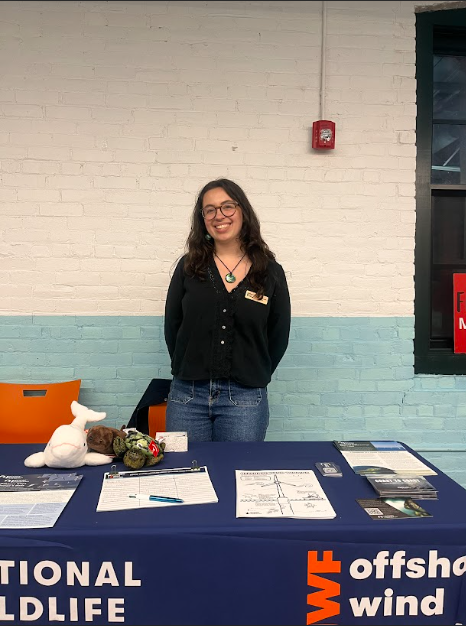
In Connecticut, the National Wildlife Federation was proud to be a sponsor of Sierra Club Connecticut’s Earth Day event, which brought community members together for music, storytelling, and shared learning.
The New Jersey Board of Public Utilities (NJBPU) voted to terminate the New Jersey “State Agreement Approach” (SAA), a first-of-its-kind agreement between a US state and its regional grid operator, in this case PJM Interconnection, to develop coordinated transmissions projects for offshore wind projects to get energy to the grid efficiently. Power Play New Jersey said, “It was an innovative policy, well designed, and working as intended. What changed is not New Jersey’s commitment to clean energy. What changed is the federal and economic landscape the SAA was built to serve.”
On the debut episode of her namesake radio show “Ask Governor Sherrill,” New Jersey Governor Mikie Sherrill laid out priorities for renewable energy in the state but declined to outline a plan for offshore wind. “If that makes sense in the future, New Jersey will move into it,” the governor said.
Plans to develop Rhode Island’s South Quay for the offshore wind industry have stalled in response to federal pushback on offshore wind. “It’s not going to be a wind hub as it was originally intended to be,” East Providence Mayor Roberto Da Silva stated in a recent interview with Ocean State Media, “but it will be a port that will serve our state and our community and create economic development.” The public funds budgeted for the South Quay, a 50-acre parcel of land that was once “heralded as Rhode Island’s ticket to lead the construction sector” of the US offshore wind industry, have been covertly diverted to other projects.
Good news in Massachusetts! Vineyard Wind, which finished construction on its 62 turbines last month, activated its power contracts with utilities. This means that power from Vineyard Wind will be sold at a fixed rate of $69.50 per megawatt-hour. The agreement is estimated to save Massachusetts ratepayers an average of 1.4 cents per kilowatt hour on their electricity bills.
Nantucket is requesting public comment on Vineyard Wind’s debris and infrastructure failure incident respondent plan. The plan, which includes details regarding notification of incident and local representation Vineyard Wind’s incident management team, is a response to the turbine blade collapse that occurred in summer 2024 off the shore of Nantucket in Massachusetts.
The Wampanoag Tribe of Gay Head (Aquinnah) in Massachusetts filed a lawsuit against the Bureau of Ocean Energy Management (BOEM) for its approval of Sunrise Wind, arguing that BOEM did not sufficiently consider the Tribe’s input during their consultations in the project permitting process.
An article in the Maine Beacon highlighted how the lease buyback deal with TotalEnergies will impact Mainers and New England households more generally. “Maine, like every other state in the country, is tethered to a global market for a massive amount of our energy,” says Frances Eanes, executive director of the Maine Labor Climate Council. “When there are shocks to that system… we’re tremendously vulnerable.” Offshore wind offers the opportunity to stabilize energy costs.
MID-ATLANTIC (DE, MD, NC, VA)
As Coast Virginia Offshore Wind (CVOW) begins to deliver power to the grid, Virginia lawmakers passed legislation aimed at growing the offshore wind workforce. House Bill 67, sponsored by Representative Michael Feggans, directs the Virginia Department of Energy to identify and develop workforce training resources specifically for offshore wind, with the aim to prepare Virginians for jobs in turbine manufacturing, installation, operations, and maintenance as the offshore wind industry grows on the East Coast.
In Delaware, lawmakers are considering repowering the shuttered Indian River coal plant as a natural gas facility or a small nuclear reactor to address potential future energy shortages. While the power plant is the intended point of interconnection for the US Wind project, lawmakers have discussed everything from offshore wind, to solar, to modular nuclear reactors as energy generating uses for the site.
A Delaware judge upheld a law that allows for the construction of a land-based substation for the proposed US Wind project. In a statement, Delaware Attorney General Kathy Jennings said the “ruling makes clear that Delaware’s energy future is a statewide issue that should be decided by the whole State — not one municipality.”
The Delaware People for Offshore Wind Energy Resources (POWER) Coalition recently released the Offshore Wind & Delaware factsheet. Read and download it here.
GULF OF MEXICO (LA, TX)
Environment Texas recently wrapped up their Renewable Energy Roadshow, a series of clean energy forums across the coast, from Beaumont to Brownsville, to discuss the future of clean energy and conservation in their communities. The roadshow ended with a summit in Austin. NWF participated in a panel discussion about best practices to reduce environmental impacts of clean energy projects. Progress Texas recorded a podcast where you can listen to the forum or you can watch on their Facebook page.
As pictured above in Connecticut, NWF’s Offshore Wind Team was in the field this month to celebrate Earth Day. We sponsored several events in Texas including the Coastal Bays Foundation’s Earth Day Bay Day celebration in Corpus Christi, Earth Day at Discovery Green in Houston, and the San Bernard National Wildlife Refuge’s Migration Celebration in Brazoria. NWF staff had great conversations with participants about Texas’ leadership in wind energy, how Texas is involved in offshore wind projects on the East Coast, and how NWF advocates for responsible development that protects wildlife.
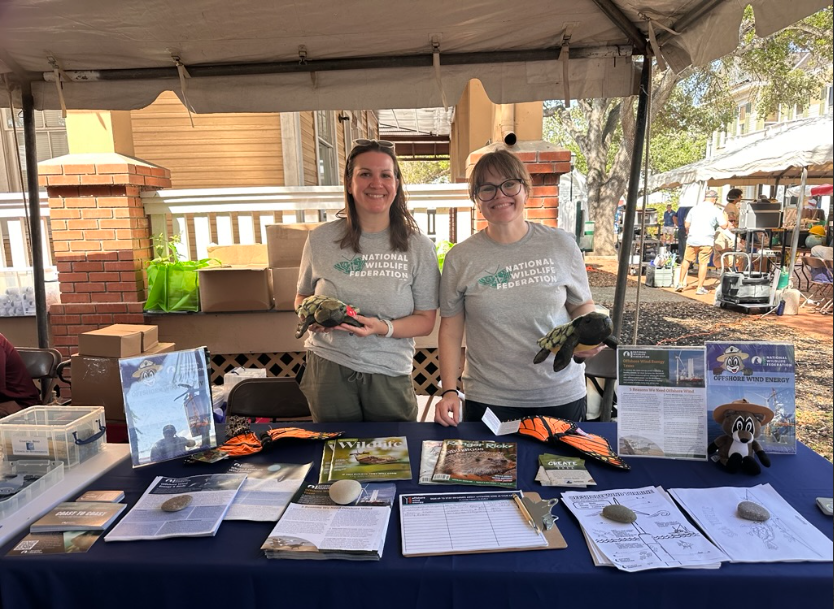
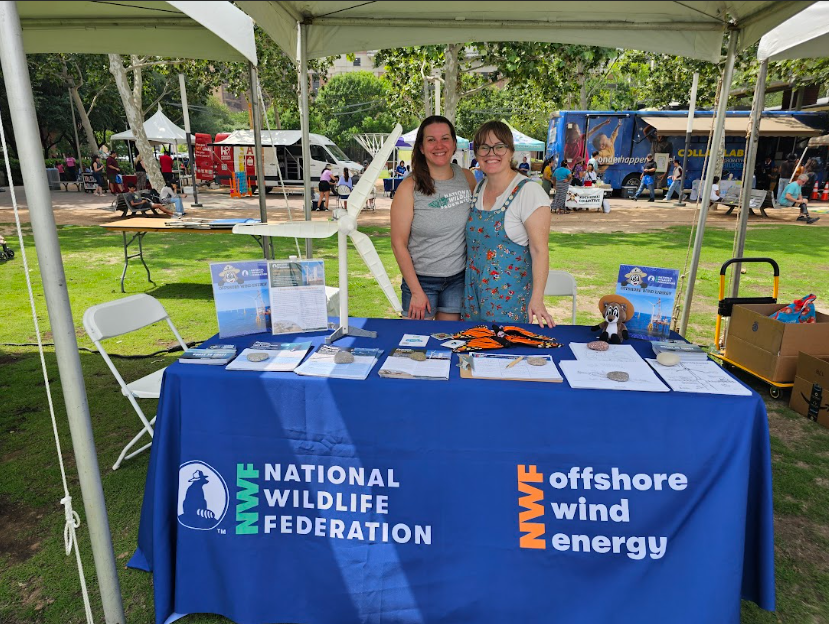
Inside Climate News spoke to our Gulf Campaign Manager, Stacy Ortego, earlier this month to learn more about why Texas, the leader of onshore wind energy, doesn’t have any offshore. “In the Gulf,” said Ortego, “we have a very robust offshore energy development industry that’s really poised to take advantage of offshore wind opportunities.”
In Louisiana, the Southeastern Wind Coalition (SEWC) and GNO Inc, in partnership with the Southern Renewable Energy Association’s “Powering Louisiana” initiative hosted the Powering Louisiana forum, which brought together industry, government, and public-sector stakeholders for discussions on the critical issues limiting new power generation in Louisiana—transmission infrastructure, community engagement, market development, and policy. A white paper is forthcoming summarizing roundtable discussions. In the meantime, here are some initial insights from SEWC.
PACIFIC (CA, HI, OR, WA)
In Oregon, the Department of Land Conservation and Development (DLCD) closed its comment period on their Offshore Wind Energy Draft Roadmap. All information regarding the Oregon OSW Energy Roadmap process can be found here. NWF submitted comments with several partners and looks forward to ongoing collaboration to support Oregon’s long-term offshore wind endeavors.
In California, the Central Coast Community Benefits Coalition has launched an offshore wind community benefits survey (English | Spanish) for community members living in the Central Coast from Ventura to Cambria to provide input. The Coalition is interested in gauging the community members’ priorities for offshore wind development, the potential for offshore wind energy to come onshore on the Central Coast, as well as the opportunity for maintenance and operation port(s) in the region.
On the Central Coast, this month the County of San Luis Obispo released a report on their Central Coast Offshore Wind O&M Infrastructure Study.
NWF hosted a press briefing on the Central Coast of California with organizing partners to highlight the work being done to ensure offshore wind is developed responsibly. This event was held as the California Coastal Commission approved the Statewide Strategy for the Coexistence of California Fishing Communities and Offshore Wind Energy.
Climate First: Replacing Oil and Gas (CFROG) and Central Coast Climate Justice Network (CCCJN) are hosting two events in May in Ventura and Oxnard titled Past, Present, Possibilities: Power on the Central Coast designed for participants to learn about the legacy of energy and power in Ventura and help shape a community vision for the future of clean energy on the Central Coast.
RESOURCES:
The Offshore Wind Effection: animation from Union of Concerned Scientists
Oceantic: Offshore Wind Works
Recent Turn Forward Offshore Wind Public Opinion Polling: Overview & Downloadable Assets

Recent
Final Oregon Offshore Wind Energy Roadmap Public Meeting
April 23, 2026 | Link Here
Upcoming
NYSERDA’s Learning from the Experts Series: Port Infrastructure Financing for Offshore Wind
Wednesday, May 13 | 12 – 1 PM ET | Register
In this webinar, Philip Bassil with Northgreen Capital will discuss financing structures and risk allocation for port upgrades to support offshore wind, as well as other uses. This webinar is part of the Learning from the Experts series hosted by NYSERDA’s Offshore Wind Team and featuring experts in key offshore wind topics, including wind farm technologies, development practices, regulatory processes, and research initiatives.
2026 Pacific Offshore Wind Summit
May 18 – 20 | Long Beach, CA | Register
The Pacific Offshore Wind Summit brings together state and federal officials, industry leaders, and other stakeholders to mobilize support and build momentum for California to meet its ambitious planning goals to generate up to 5 gigawatts (GW) from offshore wind by 2030 and a nation-leading 25 GW by 2045.
Past, Present, Possibilities: Power on the Central Coast
May 21 | Ventura, CA | 5:30 – 7 PM | Register
May 28 | Oxnard, CA | 5:30 to 7:00 PM | Register
These two events are designed for participants to learn about the legacy of energy and power in Ventura and help shape a community vision for the future of clean energy on the Central Coast.
Offshore Wind Alliance: Offshore Wind Public Opinion Polling
June 4 | 12:00 ET | Register
Policymakers are making consequential decisions about America’s energy mix. Turn Forward, along with Republican polling firm The Tarrance Group, just released new polling data to show where the public stands. Join the Offshore Wind Alliance results from polling across 13 states – including Maryland and Delaware – which is the latest in a longitudinal series tracking voter attitudes on offshore wind, energy costs, and energy security.